Aporocotylidae
Taxonomy
- Kingdom: Animalia
- Phylum: Platyhelminthes
- Class: Trematoda
- Order: Diplostomida
- Family: Aporocotylidae
Aporocotylidae is a family of trematodes within the order Diplostomida, commonly referred to as fish blood flukes. Established by Odhner in 1912, the family is classified under the suborder Diplostomata and the superfamily Schistosomatoidea. It comprises more than 40 genera, including Aporocotyle, Cardicola, Sanguinicola, Skoulekia, Chimaerohemecus, and Pearsonellum. The family is widely distributed globally, with over 1,300 documented occurrence records spanning a broad range of latitudes and longitudes.[1][2][3][4]
These parasites infect both freshwater and marine fish, often localizing in the gills and heart. Some species exhibit highly specialized infection sites, such as Skoulekia meningialis, which is found surrounding the brain of the Mediterranean common two-banded seabream. Infections, such as those caused by Cardicola forsteri in ranched southern bluefin tuna, can result in significant economic impacts on the fish ranching industry. The presence of these flukes is often indicated by the accumulation of eggs in gill filaments, which may cause host pathology. Identification is typically achieved through a combination of morphological and molecular data.[5][3]
Visual Description
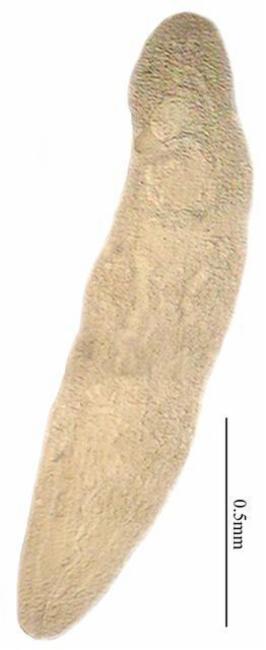
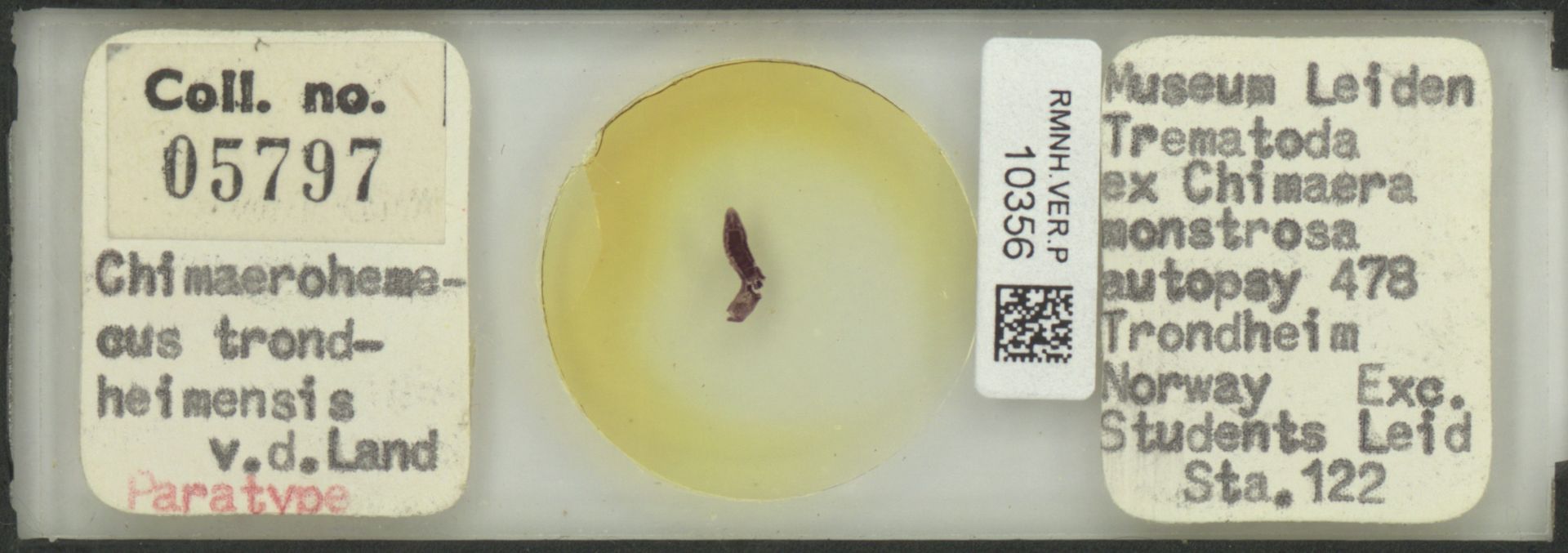
Members of the Aporocotylidae typically exhibit an elongated, flattened, leaf-like body morphology. Preserved specimens, such as those of Pearsonellum corventum, display a textured surface with internal structures faintly visible through the body wall. Other representatives, like Chimaerohemecus trondheimensis, appear as small, dark, elongated, and slightly curved organisms when mounted for microscopic examination.
Gallery
References
- ↑ Aporocotylidae. Global Biotic Interactions. https://www.globalbioticinteractions.org/?targetTaxon=Aporocotylidae. Accessed 2026-09-05.
- ↑ Aporocotylidae. GBIF. https://www.gbif.org/species/4282312. Accessed 2026-09-05.
- 1 2 Aporocotylidae. Wikipedia. https://en.wikipedia.org/wiki/Aporocotylidae. Accessed 2026-09-05.
- ↑ Dataset view for Animalia / Platyhelminthes / Trematoda / Diplostomida / Aporocotylidae constructed from imageomics/TreeOfLife-200M records under this taxonomic path. Hugging Face Datasets. https://huggingface.co/datasets/imageomics/TreeOfLife-200M
- ↑ Sho Shirakashi; Kazunobu Tsunemoto; Claire Webber; Kirsten Rough; David J. Ellis; Kazuo Ogawa. Two Species of Cardicola (Trematoda: Aporocotylidae) Found in Southern Bluefin Tuna Thunnus maccoyii Ranched in South Australia. Fish Pathology. 2013. https://doi.org/10.3147/jsfp.48.1.