Aphrocallistidae
Taxonomy
This page represents the following TreeOfLife-200M taxonomic path.[1]
- Kingdom: Animalia
- Phylum: Porifera
- Class: Hexactinellida
- Order: Sceptrulophora
- Family: Aphrocallistidae
Visual Description
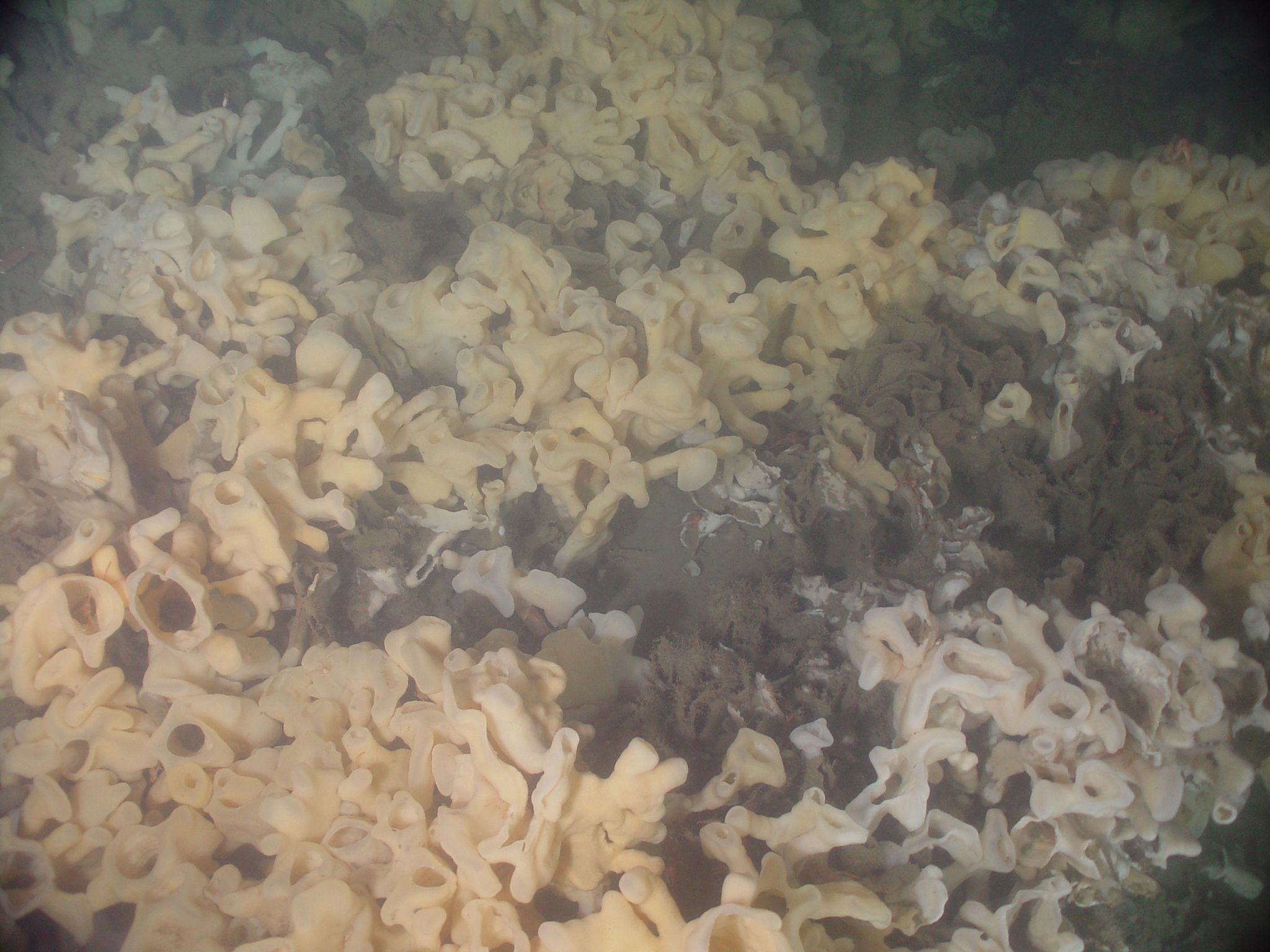
Members of Aphrocallistidae (glass sponges) are typically observed as lopsided goblet- to finger-like “cup” morphologies, with the siliceous skeleton often visible in imagery.
Example taxa observed in dataset imagery
- Heterochone calyx — common name reported as Fingered goblet glass sponge in dataset records.
- Aphrocallistes vastus — common name reported as Cloud glass sponge in dataset records.
These forms are consistent with the family-level assignment across multiple image records aggregated under the Aphrocallistidae path.[1]
Ecology and environmental relevance (mining disturbance)
Hexactinellid glass sponges—including Aphrocallistidae—are relevant to assessing impacts of deep-sea disturbance because they can function as suspension feeders and may be associated with suitable substrata such as nodule-bearing habitats.
In a long-term revisit of simulated polymetallic nodule mining (Peru Basin, DISCOL revisit after 26 years), Porifera density dropped most strongly in the most directly disturbed “plough track” habitat, and the authors link these changes to loss of habitat/substratum needed by nodule-associated suspension feeders. Aphrocallistidae were included among the Porifera taxa imaged/measured, and an Aphrocallistidae morphotype is represented in example imagery.
The same work interprets long-lasting impacts in terms of reduced suspension-feeder standing stock in disturbed tracks, with mechanisms including removal/burial of hard substratum and microhabitat features that can limit recolonization.
Species occurrence and data access
Aphrocallistidae are represented in global biodiversity data portals (e.g., GBIF), where the taxon is used as an indexed family concept for occurrence records.
Gallery





References
- 1 2 Dataset view for Animalia / Porifera / Hexactinellida / Sceptrulophora / Aphrocallistidae constructed from imageomics/TreeOfLife-200M records under this taxonomic path. Hugging Face Datasets. https://huggingface.co/datasets/imageomics/TreeOfLife-200M.
- ↑ Erik Simon‐Lledó; Brian J. Bett; Veerle A.I. Huvenne; Kevin Köser; Timm Schoening; Jens Greinert; Daniel O. B. Jones. Biological effects 26 years after simulated deep-sea mining. Scientific Reports. 2019. https://doi.org/10.1038/s41598-019-44492-w.
- ↑ Aphrocallistidae. GBIF. https://www.gbif.org/species/3231. Accessed 2026-07-09.