Anopheles triannulatus
Taxonomy
This page represents the following TreeOfLife-200M taxonomic path.[1]
- Kingdom: Animalia
- Phylum: Arthropoda
- Class: Insecta
- Order: Diptera
- Family: Culicidae
- Genus: Anopheles
- Species: Anopheles triannulatus
Visual Description
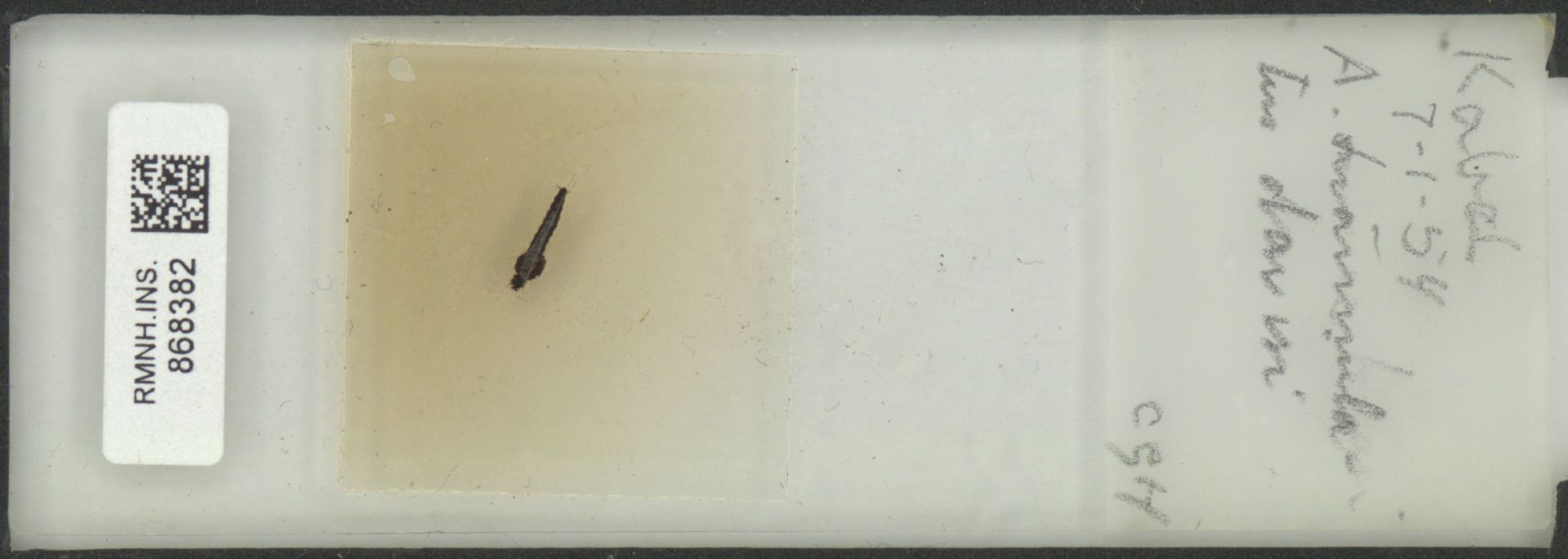
Based on examination of museum specimens from the TreeOfLife-200M dataset, Anopheles triannulatus exhibits characteristic morphological features of the genus Anopheles [1]. The specimens display the typical slender, elongated body form of a mosquito, with long, delicate legs and narrow, veined wings. The coloration is generally muted, consistent with typical Anopheles appearance, though specific diagnostic patterns on the palps or wings are difficult to resolve in the available imagery [1].
Overview
Anopheles triannulatus is a species of mosquito in the family Culicidae, first described by Neiva and Pinto in 1922 [2]. It is recognized as part of a complex of closely related species, the Anopheles triannulatus complex, which includes Anopheles triannulatus s.s., Anopheles halophylus, and a putative species referred to as Anopheles triannulatus C [3].
Phylogeography and Structure
Molecular phylogenetic research, utilizing markers such as mitochondrial COI, the nuclear white gene, and rDNA ITS2, has revealed significant genetic structure within the Anopheles triannulatus complex [3]. The complex is divided into two major clades: Clade I (Amazonian) and Clade II (trans-Andean and Amazon Delta) [3]. Evidence suggests that An. halophylus and An. triannulatus C may be undergoing incipient speciation [3]. The evolutionary history of the An. triannulatus group is thought to have a trans-Andean origin [3].
Gallery
References
- 1 2 3 Dataset view for Animalia / Arthropoda / Insecta / Diptera / Culicidae / Anopheles / triannulatus constructed from imageomics/TreeOfLife-200M records under this taxonomic path. Hugging Face Datasets. https://huggingface.co/datasets/imageomics/TreeOfLife-200M.
- ↑ Anopheles triannulatus Neiva & Pinto, 1922. GBIF. https://www.gbif.org/species/1650493. Accessed 2026-07-15.
- 1 2 3 4 5 Marta Moreno; Sara A. Bickersmith; Wesley Harlow; Jessica Hildebrandt; Sascha N McKeon; Teresa Fernandes Silva-do-Nascimento; José R. Loaiza; Freddy Ruíz-López; Ricardo Lourenço‐de‐Oliveira; Maria Anice Mureb Sallum; Eduardo Sterlino Bergo; Gary N. Fritz; Richard C. Wilkerson; Yvonne Marie Linton; María J. Dantur Juri; Yadira Rangel; Marinete Marins Póvoa; Lina A. Gutiérrez-Builes; Margarita M. Correa; Jan E. Conn. Phylogeography of the neotropical Anopheles triannulatus complex (Diptera: Culicidae) supports deep structure and complex patterns. Parasites & Vectors. 2013. https://doi.org/10.1186/1756-3305-6-47.