Anopheles thomasi
Taxonomy
This page represents the following TreeOfLife-200M taxonomic path.[1]
- Kingdom: Animalia
- Phylum: Arthropoda
- Class: Insecta
- Order: Diptera
- Family: Culicidae
- Genus: Anopheles
- Species: Anopheles thomasi
Visual Description
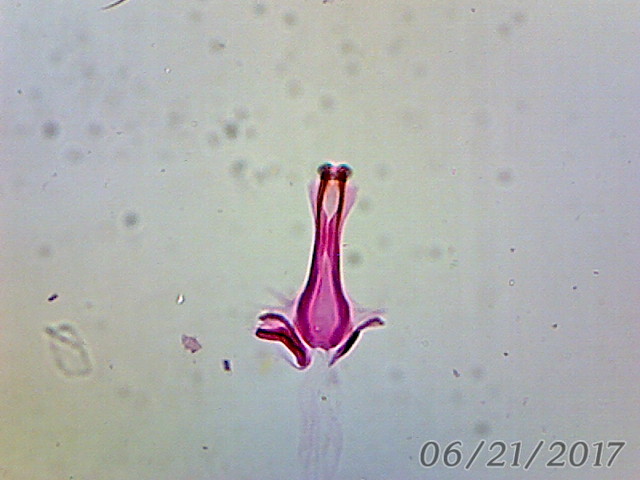
The available imagery for Anopheles thomasi depicts microscopic anatomical structures, likely associated with the reproductive morphology of the species.[1] The observed specimen exhibits a distinct, elongated, and symmetrical central structure with a bulbous base that tapers towards a narrower, neck-like region, terminating in a bifurcated or paired apical feature.[1] Lateral projections are visible near the base of this structure, contributing to its overall complex, flask-like appearance.[1]
Ecology and Distribution
Anopheles thomasi is a species classified within the subgenus Stethomyia of the genus Anopheles.[2] As a member of this subgenus, it is considered a forest-dwelling mosquito.[2] Larvae of Stethomyia species are typically found in well-shaded, small streams and swampy environments.[2]
While species in this subgenus are not recognized for medical importance, females are known to bite humans.[2] The species has been recorded in Bolivia, Brazil, Colombia, and Peru.[2]
Gallery
References
- 1 2 3 4 Dataset view for Animalia / Arthropoda / Insecta / Diptera / Culicidae / Anopheles / thomasi constructed from imageomics/TreeOfLife-200M records under this taxonomic path. Hugging Face Datasets. https://huggingface.co/datasets/imageomics/TreeOfLife-200M.
- 1 2 3 4 5 Maria Anice Mureb Sallum; Ranulfo González Obando; Nancy Carrejo; Richard C. Wilkerson. Identification keys to the Anopheles mosquitoes of South America (Diptera: Culicidae). I. Introduction. Parasites & Vectors. 2020. https://doi.org/10.1186/s13071-020-04298-6.