Amauromyza abnormalis
Amauromyza abnormalis (Malloch, 1913) is a species of leaf-mining fly in the family Agromyzidae. It is known to act as a stem borer in certain plants of the family Amaranthaceae.
Taxonomy
This page represents the following TreeOfLife-200M taxonomic path.[1]
- Kingdom: Animalia
- Phylum: Arthropoda
- Class: Insecta
- Order: Diptera
- Family: Agromyzidae
- Genus: Amauromyza
- Species: Amauromyza abnormalis
Visual Description
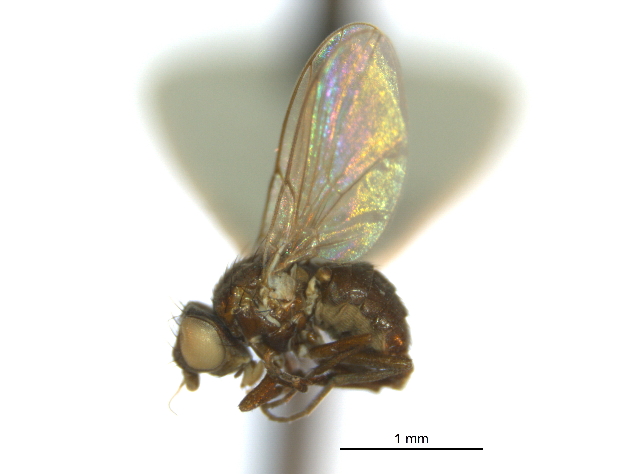
Adults of Amauromyza abnormalis are characterized by a predominantly black body, including the frons, antennae, ocellar triangle, halteres, mesonotum, scutellum, abdomen, and legs. The head features a frons that is twice the width of the eye and projects above it. The third antennal segment is rounded and pubescent, and the arista possesses long, distinct hairs. The gena is angular and approximately half the eye height. The eyes are glabrous in both sexes. The mesonotum bears (3+1) pairs of dorsocentral bristles and four rows of acrostichal hairs between them. The calypter is dark, featuring a black margin and fringe. The costa extends to vein M1+2.[2]
Ecology and Biology
The larvae of Amauromyza abnormalis are stem borers of plants in the family Amaranthaceae, including Amaranthus cruentus L., A. hibridus L., and A. hypocondriacus L. Multiple larvae, sometimes up to 35 of varying developmental stages, have been observed feeding within a single stem. Upon reaching maturity, the larva bores an exit hole to pupate in the soil.[2]
Distribution
The species is distributed across North America, with records in Canada, the United States, and Mexico. In Mexico, it has been documented in locations such as Tulyehualco, Xochimilco, D.F.; Montecillo, Texcoco, State of Mexico; and San Miguel del Milagro, Nativitas, Tlaxcala.[2]
Gallery
References
- ↑ Dataset view for Animalia / Arthropoda / Insecta / Diptera / Agromyzidae / Amauromyza / abnormalis constructed from imageomics/TreeOfLife-200M records under this taxonomic path. Hugging Face Datasets. https://huggingface.co/datasets/imageomics/TreeOfLife-200M.
- 1 2 3 Rogelio E. Palacios Torres; Jesús Romero–Nápoles; Jean Étienne; José Luis Carrillo-Sánchez; Jorge Váldez-Carrasco; Hiram Bravo-Mojica; Stephen D. Koch; Víctor López‐Martínez; Antonio P. Terán-Vargas. Identificación, distribución y plantas hospederas de diez especies de agromyzidae (insecta: diptera), de interés agronómico en México. ACTA ZOOLÓGICA MEXICANA (N S ). 2008. https://doi.org/10.21829/azm.2008.243905.