Alloinfundiburictus
Taxonomy
Alloinfundiburictus is a genus of digenean trematodes belonging to the family Monorchiidae. The genus was established in 2020 by Wee, Cutmore, Pérez-del-Olmo, and Cribb as part of a taxonomic revision that restructured the genus Lasiotocus.[1][2][3][4]
Species within this genus are known to parasitize various fish species. Documented species include Alloinfundiburictus beauforti, A. longicaecum, A. lintoni, A. costaricae, and A. cacuminatus, with specimens of the latter held in museum collections such as the Queensland Museum.[1][4]
Visual Description
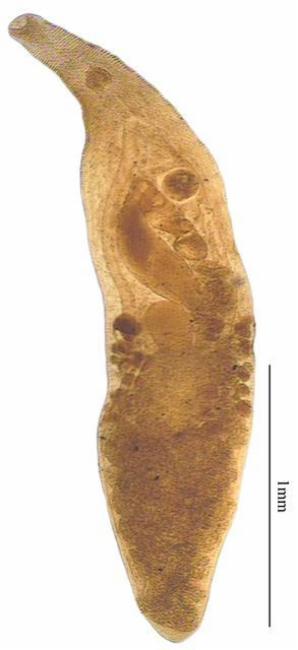
Specimens of Alloinfundiburictus, such as A. cacuminatus, appear as elongated, leaf-shaped, and flattened trematodes. The body tapers toward the anterior end. When stained and viewed under microscopy, internal anatomical features, including the digestive tract and reproductive organs, are visible as darker, distinct regions within the translucent body. A 1mm scale bar is typically used to indicate the size of these organisms.
Gallery
References
- 1 2 Alloinfundiburictus. Global Biotic Interactions. https://www.globalbioticinteractions.org/?targetTaxon=Alloinfundiburictus. Accessed 2026-09-05.
- ↑ Alloinfundiburictus. NCBI Nucleotide. https://www.ncbi.nlm.nih.gov/nuccore/?term=txid3035864[organism:exp]. Accessed 2026-09-05.
- ↑ Alloinfundiburictus Wee, Cutmore, Pérez-del-Olmo & Cribb, 2020. GBIF. https://www.gbif.org/species/10855490. Accessed 2026-09-05.
- 1 2 Dataset view for Animalia / Platyhelminthes / Trematoda / Plagiorchiida / Monorchiidae / Alloinfundiburictus constructed from imageomics/TreeOfLife-200M records under this taxonomic path. Hugging Face Datasets. https://huggingface.co/datasets/imageomics/TreeOfLife-200M