Alaria
Taxonomy
Alaria is a genus of trematodes within the family Diplostomidae, order Diplostomida, and class Trematoda. First described by Schrank in 1788, the genus comprises several species that infect a wide range of mammalian hosts. While molecular phylogenetic studies have utilized both ribosomal (28S) and mitochondrial (cox1) gene data to investigate the evolutionary relationships within the group, species-level identification remains challenging due to significant morphological variation and the limitations of historical taxonomic records.[1][2][3]
These trematodes are typically associated with wildlife in wetland habitats, where they utilize various animals as hosts. Definitive hosts often include carnivores such as the red fox, while wild boar and other mammals may serve as paratenic hosts. The larval stages, known as mesocercariae, can infect humans, leading to a zoonotic condition called alariosis. Clinical manifestations of human infection range from asymptomatic cases to severe respiratory or neurological symptoms, including larva migrans. In infected hosts, mesocercariae are frequently found in subcutaneous or muscular tissues, where they may form distinct, whitish, round or oval nodules characterized by inflammatory cell infiltration.[4]
Visual Description
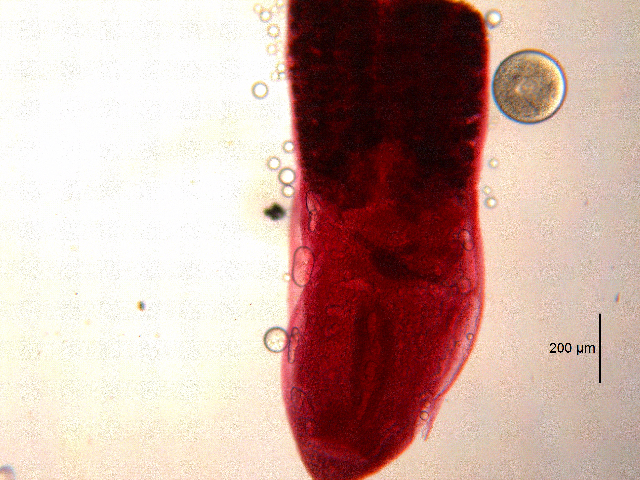
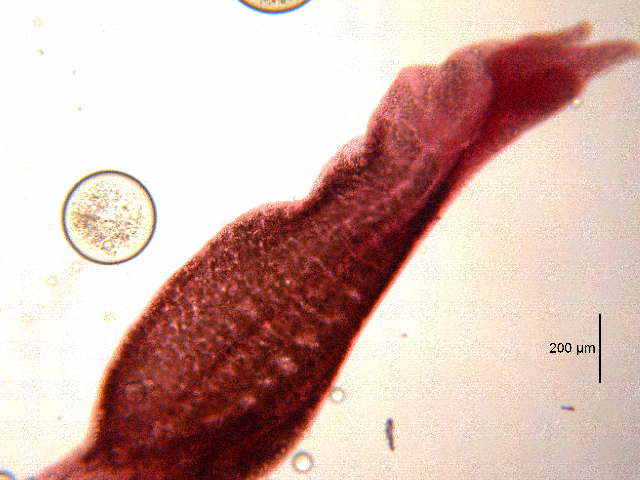
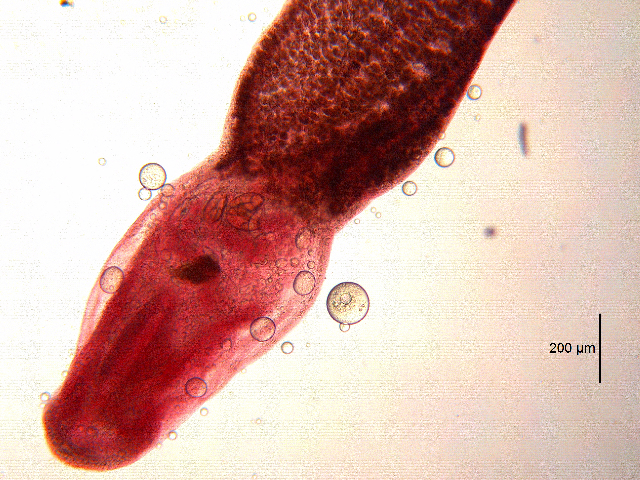
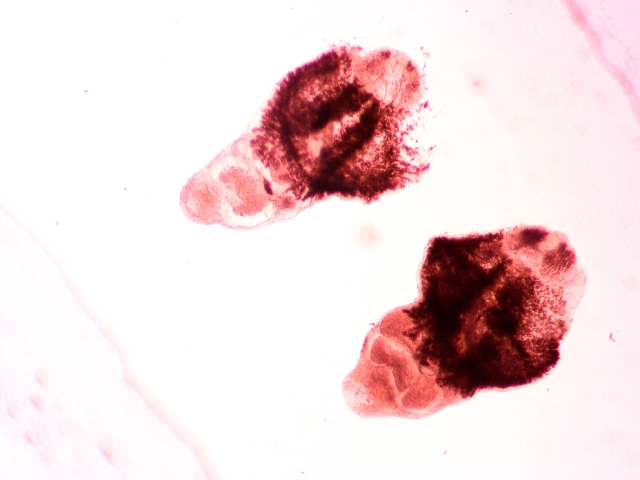
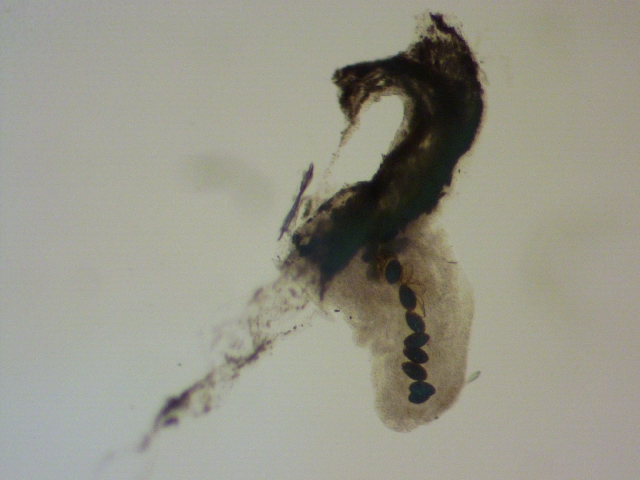
Specimens of Alaria are typically observed as flattened, stained trematodes. They exhibit a characteristic elongated and somewhat bilobed body shape, which is diagnostic of many diplostomid flukes. Microscopic examination of these stained specimens reveals internal anatomical structures, with a distinct, prominent anterior region and a broader posterior body.
Gallery
References
- ↑ Alaria Schrank 1788 - Plazi TreatmentBank. Plazi TreatmentBank. http://tb.plazi.org/GgServer/xhtml/03F7830DFF8BFFA1FEFFAD98FDEDFEC1. Accessed 2026-09-05.
- ↑ Alaria. NCBI Nucleotide. https://www.ncbi.nlm.nih.gov/nuccore/?term=txid138589[organism:exp]. Accessed 2026-09-05.
- ↑ Dataset view for Animalia / Platyhelminthes / Trematoda / Diplostomida / Diplostomidae / Alaria constructed from imageomics/TreeOfLife-200M records under this taxonomic path. Hugging Face Datasets. https://huggingface.co/datasets/imageomics/TreeOfLife-200M
- ↑ Flaviu Tăbăran; Attila D. Sándor; Mihai Marinov; C. Cătoi; Andrei Daniel Mihalca. Alaria alataInfection in European Mink. Emerging infectious diseases. 2013. https://doi.org/10.3201/eid1909.130081.