Aephnidiogenidae
Taxonomy
Aephnidiogenidae is a family of digenean trematodes within the order Plagiorchiida and the superfamily Lepocreadioidea. Established by Yamaguti in 1934, the family includes several genera, such as Aephnidiogenes, Austroholorchis, Holorchis, Neolepocreadium, Pseudaephnidiogenes, Stegodexamene, and Tetracerasta. Members of this family are characterized by specific ultrastructural features of the spermatozoon, including a discontinuous, submembranous layer of electron-dense material that partially surrounds one of the axonemes in the anterior extremity, a trait shared with other families in the Lepocreadioidea.[1][2][3][4]
These trematodes are parasites of various fish species, with hosts documented across families including Anguillidae, Eleotridae, Galaxiidae, Percichthyidae, and Retropinnidae. Their life cycles involve molluscan intermediate hosts, such as Potamopyrgus antipodarum and Posticobia brazieri. The family exhibits a broad geographic distribution, with occurrence records spanning a wide range of latitudes and longitudes.[1][3]
Visual Description
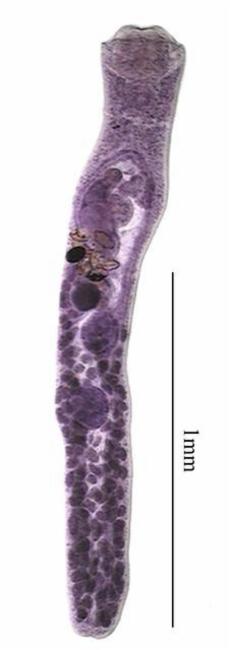
Members of the family are typically elongated and dorsoventrally flattened. Stained specimens reveal internal anatomy, including an oral sucker located at the anterior end, complex reproductive organs, and numerous vitelline follicles that occupy the posterior region of the body.
Gallery
References
- 1 2 Aephnidiogenidae. Global Biotic Interactions. https://www.globalbioticinteractions.org/?targetTaxon=Aephnidiogenidae. Accessed 2026-09-05.
- ↑ Hichem Kacem; Abdoulaye J.S. Bakhoum; Catarina Eira; Lassâd Neifar; Jordi Miquel. Ultrastructural characters of the spermatozoon of the digenean Hypocreadium caputvadum Kacem et al., 2011 (Lepocreadioidea: Lepocreadiidae), an intestinal parasite of Balistes capriscus in Tunisia. Comptes Rendus Biologies. 2012. https://doi.org/10.1016/j.crvi.2012.10.002.
- 1 2 Aephnidiogenidae. GBIF. https://www.gbif.org/species/7392398. Accessed 2026-09-05.
- ↑ Aephnidiogenidae. Wikipedia. https://en.wikipedia.org/wiki/Aephnidiogenidae. Accessed 2026-09-05.