Acartophthalmites
Acartophthalmites is an extinct genus of Diptera (Acalyptratae) that lived during the Eocene epoch. Its familial relationships remain unclear, though it is tentatively classified within the superfamily Opomyzoidea and is considered most closely related to the family Clusiidae [1].
Taxonomy
This page represents the following TreeOfLife-200M taxonomic path.[2]
- Kingdom: Animalia
- Phylum: Arthropoda
- Class: Insecta
- Order: Diptera
- Family: Clusiomitidae
- Genus: Acartophthalmites
Visual Description
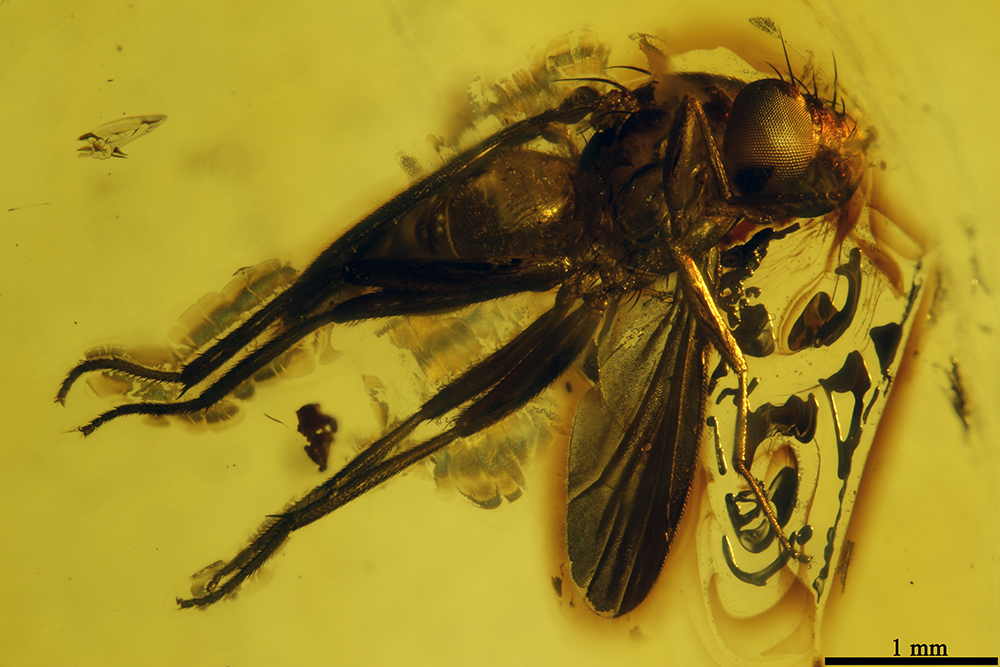
Based on fossil specimens from the TreeOfLife-200M dataset, Acartophthalmites exhibits the characteristic body plan of a small acalyptrate fly preserved in amber [2]. The specimens show a distinct, segmented body with clearly defined thoracic and abdominal regions. The wings are typically folded over the abdomen, displaying the venation patterns characteristic of the group, and the head features prominent compound eyes [2].
Biology and Distribution
The genus includes species such as Acartophthalmites willii, which was described from Eocene Baltic amber (approximately 56–33.9 Ma) [1]. Morphologically, A. willii is considered an intermediate form between previously described species of the genus, contributing to the known character diversity within this lineage [1].
Gallery
References
- 1 2 3 Ricardo Pérez‐de la Fuente; Christel Hoffeins; Jindřích Roháček. A new Acartophthalmites Hennig from Eocene Baltic amber (Diptera, Acalyptratae). ZooKeys. 2018. https://doi.org/10.3897/zookeys.737.20639.
- 1 2 3 Dataset view for Animalia / Arthropoda / Insecta / Diptera / Clusiomitidae / Acartophthalmites constructed from imageomics/TreeOfLife-200M records under this taxonomic path. Hugging Face Datasets. https://huggingface.co/datasets/imageomics/TreeOfLife-200M.