Acanthostomum
Taxonomy
- Kingdom: Animalia
- Phylum: Platyhelminthes
- Class: Trematoda
- Order: Plagiorchiida
- Family: Cryptogonimidae
- Genus: Acanthostomum
Acanthostomum is a genus of digenean trematodes within the family Cryptogonimidae, order Plagiorchiida. Established by Looss in 1899, the genus is placed in the subfamily Acanthostominae. Taxonomic revisions of the group have been conducted by researchers such as Brooks (1980) and Lamothe-Argumedo and Ponciano-Rodríguez (1986).[1][2][3]
Members of this genus are known for their broad host associations, acting as parasites or symbionts in a variety of vertebrates. Documented hosts include various fish species, such as those in the genera Pomatoschistus and Syngnathus, as well as reptiles like the American alligator (Alligator mississippiensis) and the spectacled caiman (Caiman crocodilus). They have also been identified in several bird families, including the Sternidae, Laridae, and Phalacrocoracidae, as well as the red-winged blackbird (Agelaius phoeniceus). Specific species include A. americanum, which is found in the Morelet's crocodile (Crocodylus moreletii) and includes A. acuti as a synonym, alongside other species such as A. gymnarchi, A. spiniceps, and A. absconditum.[1][2]
Visual Description
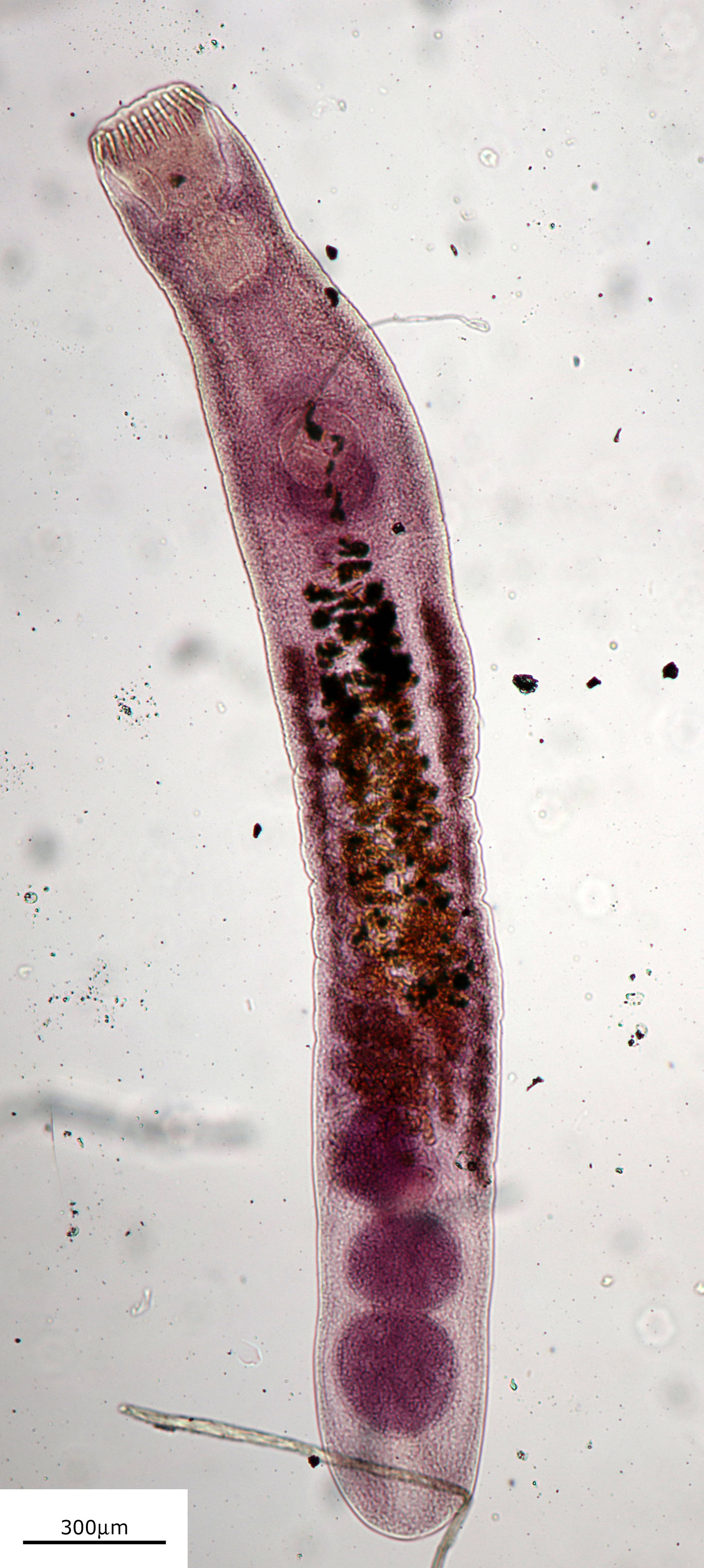
The genus is characterized by an elongated, dorsoventrally flattened body. The anterior end is distinguished by a prominent oral sucker encircled by a characteristic ring of spines. Internal anatomical features, including the pharynx, intestinal caeca, and reproductive structures such as the vitellaria and posterior testes, are typically observable in stained whole-mount preparations. Specimens may measure approximately 300 micrometers in width at their widest point.
Gallery
References
- 1 2 Acanthostomum. Global Biotic Interactions. https://www.globalbioticinteractions.org/?targetTaxon=Acanthostomum. Accessed 2026-09-05.
- 1 2 František Moravec. Some helminth parasites from Morelet\'s crocodile, Crocodylus moreletii, from Yucatan, Mexico. Folia Parasitologica. 2001. https://doi.org/10.14411/fp.2001.008.
- ↑ Dataset view for Animalia / Platyhelminthes / Trematoda / Plagiorchiida / Cryptogonimidae / Acanthostomum constructed from imageomics/TreeOfLife-200M records under this taxonomic path. Hugging Face Datasets. https://huggingface.co/datasets/imageomics/TreeOfLife-200M