Acanthobothrium coronatum
Taxonomy
Acanthobothrium coronatum is a species of cestode (tapeworm) belonging to the family Onchobothriidae within the order Onchoproteocephalidea. It is a member of the genus Acanthobothrium, which is recognized as the most species-rich genus within its order. In phylogenetic studies of Mediterranean species, A. coronatum has been categorized within a specific taxonomic grouping designated as "Category 4."[1][2][3]
As adults, these cestodes typically inhabit the spiral valves of elasmobranch fishes. The species is known to parasitize a diverse range of hosts, including Dipturus laevis, Dipturus chilensis, Myliobatis aquila, Prionace glauca, Scyliorhinus canicula, Scyliorhinus stellaris, Dasyatis pastinaca, and Mustela canis.[1][2]
Visual Description
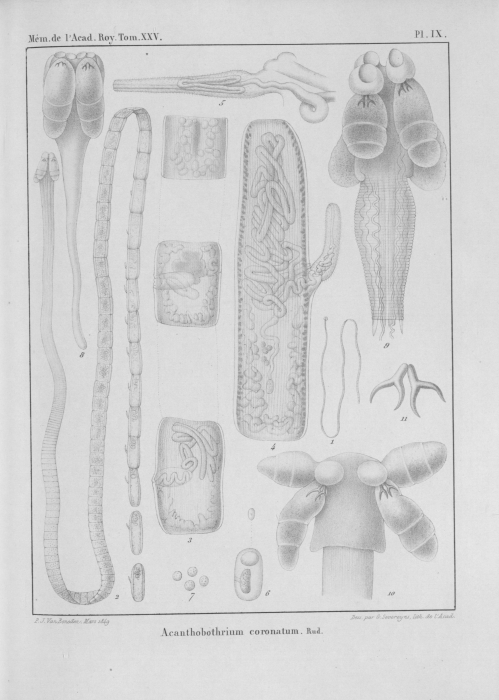
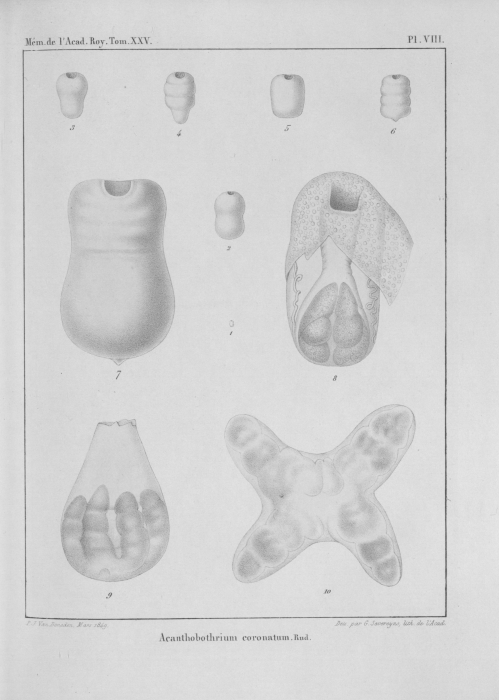
Historical scientific illustrations of A. coronatum depict the adult worm's morphology, including the scolex, which features prominent muscular bothridia and specialized hook arrangements. Detailed views show the internal reproductive structures within the proglottids, such as the uterus and testes. Additional illustrations represent various developmental stages, including rounded or lobed forms interpreted as eggs or early larval stages.
Gallery
References
- 1 2 Acanthobothrium coronatum. Global Biotic Interactions. https://www.globalbioticinteractions.org/?targetTaxon=Acanthobothrium%20coronatum. Accessed 2026-09-05.
- 1 2 S. Omari; H. S. Randhawa; Fadila Tazerouti. Re-description and molecular characterization of Acanthobothrium minus Tazerouti, Kechemir-Issad, and Euzet, 2009 (Onchoproteocephalidea, Onchobothriidae) from two skates (Elasmobranchii, Rajidae) off the Algerian Coast, Western Mediterranean. Journal of Helminthology. 2026. https://doi.org/10.1017/s0022149x26101151.
- ↑ Dataset view for Animalia / Platyhelminthes / Cestoda / Onchoproteocephalidea / Onchobothriidae / Acanthobothrium / coronatum constructed from imageomics/TreeOfLife-200M records under this taxonomic path. Hugging Face Datasets. https://huggingface.co/datasets/imageomics/TreeOfLife-200M